In 1822, Capt. David Curtis, surveyor and land agent for the Holland Land Company, arrived in Columbus, Pennsylvania with a group of young men to build a new settlement. This early land developer was great-great-great grandfather to Mary and her siblings. The house he built in 1832 still stands and is still inhabited by a Curtis on the land of the old Curtis Dairy. While viewing the house, we stopped and talked with an 18-year-old Curtis who lives nest door.
Our first stop of the day was at the nearby David Curtis Cemetery in Columbus, where many of the Curtis and Walker families are buried, including David and the parents of Mary Melissa Walker, Cecil Walker and Eloine Curtis. Also there are Cecil's parents and grandparents. The sewing chest and table that we have at one time was in the home of Cecil's parents, William and Mary Maria DeLong Walker. Here are the tombstones of Cecil and Eloine Walker and of Thomas Dewey and Amelia Walker.
Our interest in finding the landholdings of the Walker and Curtis ancestors led us to the county historical museum in Warren. We had about an hour to do some power genealogy before the museum closed, but found some valuable information. As we were going through books, Lucy at the museum dropped a photo of the house in front of Mary and asked if this would help. It certainly did, as the real structure was easy to compare a little later. We also were able to view an 1878 landholdings map of Columbus that pinpointed the Curtis property, as well as that of David Simmons. David was the father of Eugene Amidon's wife Sarah and thus great-great grandfather of Mary. We checked out that location, but there was no current development in the area except a couple of fairly new homes.
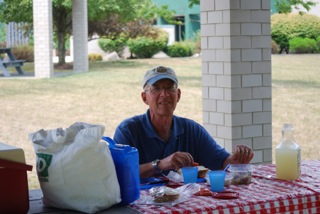
Our museum research also revealed that David, his wife and other ancestors were buried in a second cemetery in Columbus. We had some initial trouble locating Westlawn Cemetery but then discovered that it was on a map we had. There, we found gravesites of several of the Simmons and Dewey families. Besides David and his wife Elmina, also there were 3-times great grandparents John and Maria Dewey. We did not have as much luck with finding signs of the Walkers in Bear Lake, a very small community north of Columbus. We saw an old house and a sawmill that probably have family ties, but the place mostly in a ghost town. Finally, you may recall a photo of Walkers and Curtises on a picnic - we and Dave and Ann have copies. The photo probably was taken at a place over the New York line called Panama Rocks, but this usually excellent navigator made a wrong turn and we never got there before it closed.
It was wonderful to see Corry, Clymer and Columbus as places that were so important in the family history. However, it was sad to see how far Corry and Columbus have declined from their hay days. Corry has much work to do, if it is going to get back on its feet and be a viable community. We are more optimistic about Clymer. The Amish coming in are young, energetic and money earners. Corry needs somehow to bring in that young energy, too.
Tomorrow, it is on to the next generation back, Jacob and Hannah Amidon. They moved from Willington, Connecticut to Onondaga, New York, in 1864. Onondaga County now is home to more Amidons than any other place in the world.
Saturday, July 21, 2012
Friday, July 20, 2012
Corry and Clymer
What a productive day of meeting dead people with wonderful help from a couple of the living! The morning was dark and misty, but that did not deter us from getting out early. First we found the home of Eugene and Sarah Amidon at 126 E. South St. in Corry, and it is in fine shape. Eugene was the master mechanic at the tannery and, as we later found out, directed the construction of all tannery buildings other than the original. Unfortunately, much of those were lost in a huge fire in the 1940s - our B&B hostess showed us pictures.
Since the library and historical museum were not open, we then headed to Corry's Pine Grove Cemetery. The woman at the office was able to point us in the correct directions with her 3 x 5 card database (no MacPro here). Most of the Corry Amidons are buried here, not only Eugene and Sarah, but also Eugene's parents and Mary's grandparents, David and Melissa (familiar names?). Here is there stone after we did a little cleaning.
Although the Corry Historical Museum is open only on weekends, Loretta Morton responded to our phone call and opened up just for us. She handed us a treasure trove of newspaper clippings about all Amidons and Walkers in the area, so we quickly moved over to the photocopier. The clippings included not only weddings and obits, but also things like Grandpa Amidon's Eagle Scout trip to England and Eugene's near brush with a freight train. She also handed us a letter from a Karen Page looking for information about the Amidons. It turns out she is a descendant of David Amidon's sister Gertrude and, what's more, lives in Winston-Salem. Small world. Of course, we will look her up after we get home.
People were just as nice in Clymer, six miles to the north in New York. Clymer was the home of Leonard Amidon, father of John Smith Amidon and grandfather of Eugene. Unlike depressed Corry, Clymer seems to be rebounding as a farming village thanks to an influx of Amish over the past 36 years. They have bought the farms, cleaned them up and have opened other businesses like woodworking. Once again, the historical museum opened up just for us. Sue Rhenberger gave us all the plot information for the Clymer Cemetery, and showed us a pen and ink drawing of birds and done by George Jacob Amidon. He was a brother of John Smith Amidon of Corry, and became a Professor of Penmanship. Then Sue drove us out to the site of the Amidon farm at the south end of town. We returned to town to explore the cemetery finding many more Amidon graves including those of Leonard and his first wife Esther. Here is Leonard's Methodist Church, dating from the 1820s.
Tomorrow, we head for Warren County next door to find Walkers and Curtises from Mary Melissa's side of the family.
Since the library and historical museum were not open, we then headed to Corry's Pine Grove Cemetery. The woman at the office was able to point us in the correct directions with her 3 x 5 card database (no MacPro here). Most of the Corry Amidons are buried here, not only Eugene and Sarah, but also Eugene's parents and Mary's grandparents, David and Melissa (familiar names?). Here is there stone after we did a little cleaning.
Although the Corry Historical Museum is open only on weekends, Loretta Morton responded to our phone call and opened up just for us. She handed us a treasure trove of newspaper clippings about all Amidons and Walkers in the area, so we quickly moved over to the photocopier. The clippings included not only weddings and obits, but also things like Grandpa Amidon's Eagle Scout trip to England and Eugene's near brush with a freight train. She also handed us a letter from a Karen Page looking for information about the Amidons. It turns out she is a descendant of David Amidon's sister Gertrude and, what's more, lives in Winston-Salem. Small world. Of course, we will look her up after we get home.
People were just as nice in Clymer, six miles to the north in New York. Clymer was the home of Leonard Amidon, father of John Smith Amidon and grandfather of Eugene. Unlike depressed Corry, Clymer seems to be rebounding as a farming village thanks to an influx of Amish over the past 36 years. They have bought the farms, cleaned them up and have opened other businesses like woodworking. Once again, the historical museum opened up just for us. Sue Rhenberger gave us all the plot information for the Clymer Cemetery, and showed us a pen and ink drawing of birds and done by George Jacob Amidon. He was a brother of John Smith Amidon of Corry, and became a Professor of Penmanship. Then Sue drove us out to the site of the Amidon farm at the south end of town. We returned to town to explore the cemetery finding many more Amidon graves including those of Leonard and his first wife Esther. Here is Leonard's Methodist Church, dating from the 1820s.
Tomorrow, we head for Warren County next door to find Walkers and Curtises from Mary Melissa's side of the family.
Thursday, July 19, 2012
Grandparents' Home
We arrived in Corry at 5:15 after a 9 1/2 hour trip, including torrential rains in the Pittsburgh area. Our map indicated that we crossed the Ohio, but we sure did not see it - no drought here. At the PA welcome center on I-79, there is a memorial to 37 Robena miners who died 462 feet below the rest area in 1962. There also are memorabilia such as hats, lanterns and tools contributed by families of some of the deceased.
In Corry, we are staying at the Victoria on Main B&B. As it turns out, this was the house of Mr. Howard of the Howard Tannery, where Euguene Curtis Amidon worked as a carpenter and mechanic. Some of the tannery building still exists across the street, at least for awhile since it is falling apart. Eugene was Mary's great-grandfather, so you figure out his relationship to you, if any. Some of the family residences have been replaced, but one original appears to be 116 Franklin St. This was the home of Cecil and Eloine Walker, and where Mary Melissa Walker grew up. We will return under brighter skies to take a photo. More research and dead-people touring to come.
Corry has seen better days. In the 1800s, it was an industrial railroad town with oil and iron works and several tanneries. It was hit hard by the early-2008 recession, though. We drove 20 miles to find a so-so restaurant that was recommended as much better than those in town.
Mary: My thoughts are that this town was More Grandma's Lititz-up! It is smaller than Lititz by about half but it is not hard to imagine Grandma and Grandpa growing up here. Pennsylvania roots abound! Uncle Dave says our family came here in 1950 but I mostly remember going to Corning NY on that trip, where we saw glass blowers and I ran back and forth in the back seat, no doubt stepping on siblings' toes!
In Corry, we are staying at the Victoria on Main B&B. As it turns out, this was the house of Mr. Howard of the Howard Tannery, where Euguene Curtis Amidon worked as a carpenter and mechanic. Some of the tannery building still exists across the street, at least for awhile since it is falling apart. Eugene was Mary's great-grandfather, so you figure out his relationship to you, if any. Some of the family residences have been replaced, but one original appears to be 116 Franklin St. This was the home of Cecil and Eloine Walker, and where Mary Melissa Walker grew up. We will return under brighter skies to take a photo. More research and dead-people touring to come.
Corry has seen better days. In the 1800s, it was an industrial railroad town with oil and iron works and several tanneries. It was hit hard by the early-2008 recession, though. We drove 20 miles to find a so-so restaurant that was recommended as much better than those in town.
Mary: My thoughts are that this town was More Grandma's Lititz-up! It is smaller than Lititz by about half but it is not hard to imagine Grandma and Grandpa growing up here. Pennsylvania roots abound! Uncle Dave says our family came here in 1950 but I mostly remember going to Corning NY on that trip, where we saw glass blowers and I ran back and forth in the back seat, no doubt stepping on siblings' toes!
Monday, July 16, 2012
Picking Up the Trail
On July 19, Mary and I will begin a road trip back along The Amidon Trail, beginning with Erie and Warren Counties in northwestern Pennsylvania, then across the border to neighboring Chautauqua County in New York, and then to the Onondaga Valley near Syracuse, New York. The journey will take us back along the path traveled by her Amidon ancestors over several generations. And, we will include some of her Walker ancestors for good measure.
We already know the names and dates for most of Mary's ancestral family, but we are seeking to get a small glimpse into their communities. Of course, cemetery plots will be part of our itinerary. However, we also want to get an idea of where Mary's ancestors actually lived and to discover what homes may still be standing. From Google Earth photos, it is clear that some homes have been replaced over the decades, but we may still be able to experience some of what their communities were like. Aside from residences in Erie County, census data has not disclosed precise property locations. So, visits to local libraries or court houses also may on the schedule.
Mary's paternal grandparents grew up in Corry, Pennsylvania, a small town in Erie County. David Eugene Amidon was one of three children of Eugene Curtis and Sarah (Simmons) Amidon. His spouse, Mary Melissa Walker, after whom Mary is named, was one of two sisters born to Cecil and Alice Eloine (Curtis)Walker, who grew up in the Bear Lake area of nearby Columbus Township in Warren County but then traveled just a few miles to establish a family home in Corry.
Eugene's parents were John Smith and Charlotte (Curtis) Amidon. John Smith grew up in nearby Clymer, New York, just across the state border in Chautauqua County. His parents, Leonard and Esther (Smith) Amidon had a farm in Clymer. Cecil Walker's parents, William and Mary (DeLong) Walker lived in Bear Lake, where William was a lumber dealer. It was Mary DeLong's brother, Albert, who built the sewing chest that was handed down to Mary and now sits in our home in North Carolina. After Albert died in the Civil War, the chest was at the family home in Bear Lake before traveling to Lititz and Winston-Salem.
Traveling back one more generation, our trip will take us to Navarino, near Syracuse. In 1804, Jacob Amidon journeyed as a pioneer to the Onondaga Valley from Ashford, Connecticut. Only a few years earlier, other men from Ashford had reached the home of the Onondaga tribe and negotiated rights to mine the local salt deposits. The salt trade was a major factor behind construction of the Erie Canal. In Navarino, Jacob and his wife, Hannah (Pool) Amidon raised Leonard and several other children.
We already know the names and dates for most of Mary's ancestral family, but we are seeking to get a small glimpse into their communities. Of course, cemetery plots will be part of our itinerary. However, we also want to get an idea of where Mary's ancestors actually lived and to discover what homes may still be standing. From Google Earth photos, it is clear that some homes have been replaced over the decades, but we may still be able to experience some of what their communities were like. Aside from residences in Erie County, census data has not disclosed precise property locations. So, visits to local libraries or court houses also may on the schedule.
Mary's paternal grandparents grew up in Corry, Pennsylvania, a small town in Erie County. David Eugene Amidon was one of three children of Eugene Curtis and Sarah (Simmons) Amidon. His spouse, Mary Melissa Walker, after whom Mary is named, was one of two sisters born to Cecil and Alice Eloine (Curtis)Walker, who grew up in the Bear Lake area of nearby Columbus Township in Warren County but then traveled just a few miles to establish a family home in Corry.
Eugene's parents were John Smith and Charlotte (Curtis) Amidon. John Smith grew up in nearby Clymer, New York, just across the state border in Chautauqua County. His parents, Leonard and Esther (Smith) Amidon had a farm in Clymer. Cecil Walker's parents, William and Mary (DeLong) Walker lived in Bear Lake, where William was a lumber dealer. It was Mary DeLong's brother, Albert, who built the sewing chest that was handed down to Mary and now sits in our home in North Carolina. After Albert died in the Civil War, the chest was at the family home in Bear Lake before traveling to Lititz and Winston-Salem.
Traveling back one more generation, our trip will take us to Navarino, near Syracuse. In 1804, Jacob Amidon journeyed as a pioneer to the Onondaga Valley from Ashford, Connecticut. Only a few years earlier, other men from Ashford had reached the home of the Onondaga tribe and negotiated rights to mine the local salt deposits. The salt trade was a major factor behind construction of the Erie Canal. In Navarino, Jacob and his wife, Hannah (Pool) Amidon raised Leonard and several other children.
Subscribe to:
Posts (Atom)